

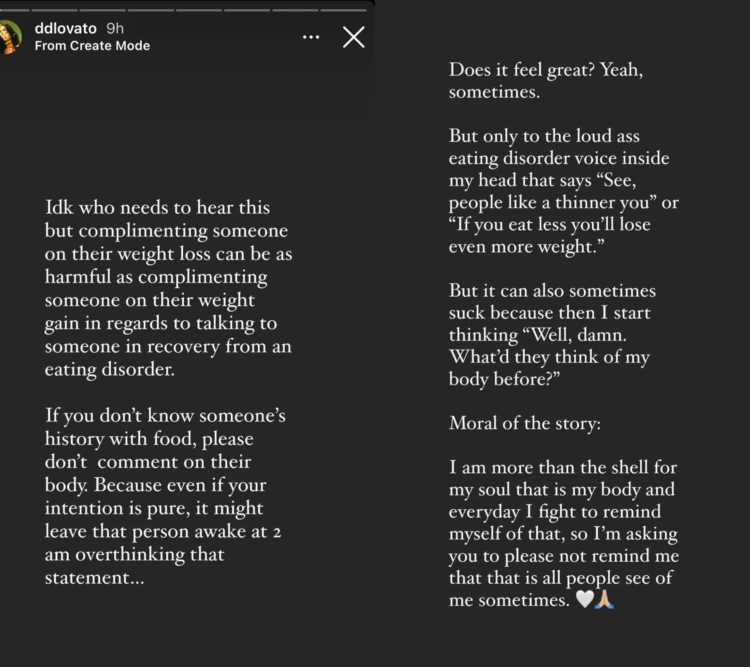
Eating disorder recovery is not a linear process, no matter what people make it out to be. Recently, Demi Lovato posted on their Instagram story to remind people that commenting on someone’s body can be harmful and hurtful, even if the “compliment†was spoken with no ill-intent.
Demi stated in their story, “Complimenting someone on their weight loss can be as harmful as complimenting someone on their weight gain,†a statement that could not be more true to me and my experience.
Text: “Idk who needs to hear this but complimenting someone on their weight loss can be as harmful as complimenting someone on their weight gain in regards to talking to someone in recovery from an eating disorder,†they wrote. “If you don’t know someone’s history with food, please don’t comment on their body. Because even if your intention is pure, it might leave that person awake at 2 am overthinking that statement.â€
“Does it feel great? Yeah, sometimes. But only to the loud ass eating disorder voice inside my head that says ‘See, people like a thinner you’ or ‘if you eat less you’ll lose even more weight.’ But it can also sometimes suck because then I start thinking ‘Well, damn. What’d they think of my body before?’â€
It’s great to notice the progress a friend is making, whether it’s in their personal life or career. It is not OK, though, to comment on their bodies unsolicited, because you never know the story behind the weight gain/loss. Many of us have a secret battle others may not know about.
What Demi mentioned about commenting on someone’s weight gain or weight loss brings me back to the years where I was buried in my eating disorder, where every day somebody commented on my body and how skinny I was getting. I thought I wasn’t good enough for the boy I was dating and with each compliment he gave me about how thin I was, I dove deeper into my anorexia nervosa (we are no longer together, it was a toxic relationship for another story). The simple comment of saying that I was looking “healthy†or looking skinny drove me to wonder how much I could push it the next day, and the next. As Demi said, their “loud ass eating disorder voice†comes through when people make such seemingly innocent comments and can trigger a downward spiral late into the night.
On the flip side, when I was working in my recovery and started to put on some weight, the first comments I received were related to how I was getting chubbier around the cheeks and that I was getting a tummy pouch. These comments came from people who I thought were my support system and their comments only sent me into doubt and fear that I was not skinny enough and that recovery was not the path I needed to be on. Though some were intended to support me in my recovery, my mind would spiral late at night and question all my actions and intentions, wondering what the worth of recovery was.
While working on loving myself, I didn’t need the voices of outsiders commenting on my body, because my body is my body. You don’t know my story and you don’t know my history, so please don’t comment on it. Instead, maybe you can ask me how my day was, how my career is going or ask me about the latest sports team if you know I’m in to sports. Why focus on my body and my appearance when I am more than a “soul in a shell of a body,†as Demi says?
Rather than spiral on these comments, I have learned to recognize that people’s comments are often a reflection of their internal struggles. I have learned to recognize my progress and affirm myself of my progress because only I know it. I have learned to take everything with a grain of salt and stay true to who I am, trusting that I know my body and only I can make decisions that affect and impact my health (of course, please make decisions along with your treatment and medical team). You are unique and more than a shell of a body. You are valued and worthy.
source https://www.programage.com/news/Demi_Lovato_Posts_a_Reminder_About_Complimenting_People_on_Weight_Loss_1621990824400546.html
0 commentaires:
Enregistrer un commentaire